
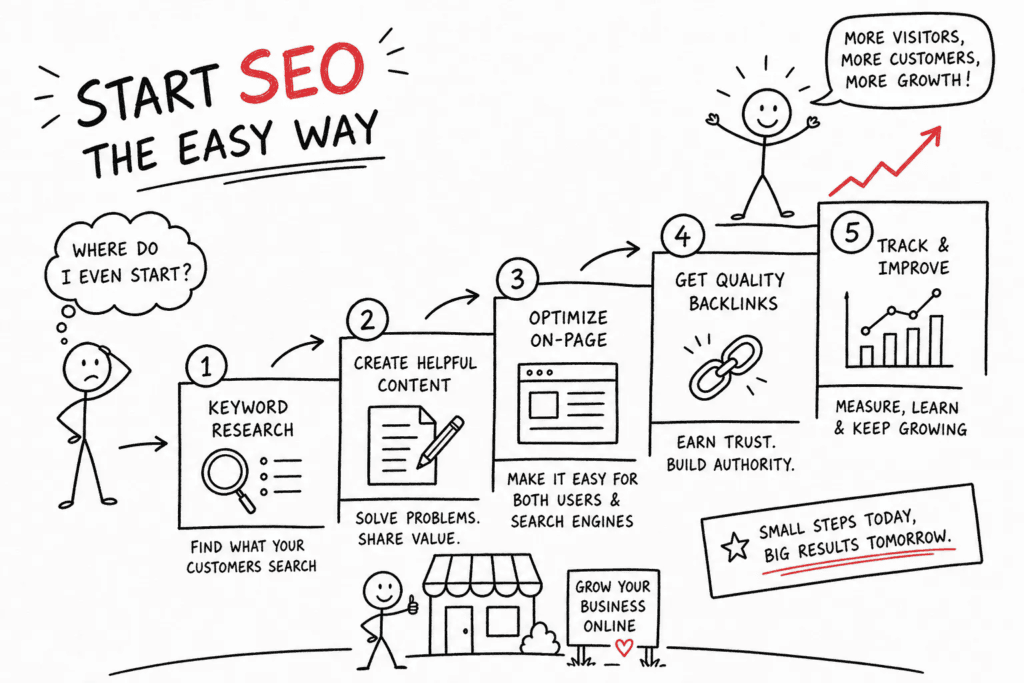
SEO marketing for beginners comes down to three things: making your site accessible to search engines, putting the right words on the right pages, and publishing content that earns trust over time. Follow a prioritised 90-day plan and any small business owner can move from an invisible website to one that generates genuine enquiries from Google, all without paying for every click.
A common pattern on small business websites is a decent-looking site that sits there doing nothing. It is not indexed properly. The title tags are CMS defaults. There is no Google Business Profile. Many of these issues have straightforward fixes when sequenced correctly.
By the end of this article, you will have a clear picture of the SEO basics, a 10-step action plan, and a 30/60/90-day checklist you can start using today.
Key takeaways
- Three connected layers: Technical SEO, on-page SEO, and content SEO each play a distinct role, and progress stalls when you skip the technical foundations.
- Measurement comes first: Set up Google Search Console and Google Analytics 4 before changing anything on the site.
- Quick wins exist: Fixing title tags, setting up your Google Business Profile, and improving page speed can produce early signals, indexing updates, impressions, and small click-through gains, often within weeks.
- Realistic timeline: Expect impressions to rise in months two to three, with first-page rankings for local or long-tail terms achievable in months four to six.
- Free tools are enough to start: The core measurement and audit stack costs nothing and covers every beginner priority.
- Organic traffic compounds: Unlike paid ads, the results of consistent SEO work accumulate over time and do not stop the moment you pause a campaign.
What is SEO, and why does it matter for your business?
The three layers every beginner needs to understand
Think of your website as a physical shop. Technical SEO makes the shop findable and easy to enter: it covers page speed, mobile usability, HTTPS, crawlable URLs, and correctly submitted sitemaps. On-page SEO is the signage inside: title tags, headings, and content structure that tell search engines exactly what each page is about. Content SEO is the product range on the shelves, helpful, intent-matched pages that give searchers a reason to stay and enquire.
A shop that is hard to find, badly signposted, and stocked with the wrong products will struggle, however good the owner is at their trade. The same logic applies online. All three layers are connected: fixing technical issues without improving content, or publishing content on a site with broken indexing, produces far weaker results than addressing them in sequence.
Why organic traffic beats paid ads for long-term growth
When someone in Manchester searches “emergency plumber near me” or “web designer Greater Manchester,” Google decides which pages to show based on relevance and authority, not budget. Organic results generate consistent, compounding traffic rather than stopping the moment a campaign pauses. That difference in cost and sustainability is precisely why SEO matters for SMEs and trades businesses that cannot afford to run paid ads indefinitely.
SEO marketing for beginners: quick wins you can make this week
Fix your title tags and meta descriptions first
A title tag is the clickable headline shown in search results, and most small business websites either leave it as the CMS default or cram in keywords awkwardly. A strong title follows a simple pattern: primary topic first, benefit or location, brand name at the end. For a Manchester-based plumber, that might look like “Emergency Plumber Manchester: 24hr Callout | City Plumbing Co.” rather than the default “Home | City Plumbing Co.”
Meta descriptions do not directly affect rankings, but a compelling one increases click-through rate. Write a single sentence that explains what the visitor will find and gives them a reason to click. Avoid listing keywords; write for the person, not the algorithm.
Set up and optimise your Google Business Profile
For local businesses, a fully completed Google Business Profile is one of the fastest routes to appearing in front of nearby customers. Claim and verify your listing, choose the most specific primary category, add every service with its own description, upload real photos of completed work, and begin actively requesting reviews from satisfied customers. Consistency between the name, address, and phone number on your website and your GBP listing is itself a ranking signal, so check that these match precisely across every platform.
Site speed and mobile performance as an immediate priority
Google uses mobile-first indexing, meaning it crawls and ranks the mobile version of your site. Run any page through PageSpeed Insights to get a free diagnostic: the most common culprits on small business websites are uncompressed images, unminified CSS, and slow hosting. Aim for a score of 90 or above and, more importantly, for passing the Core Web Vitals thresholds, Largest Contentful Paint of 2.5 seconds or less, Cumulative Layout Shift of 0.1 or less, and Interaction to Next Paint (INP) of approximately 200 milliseconds or less, each measured at the 75th percentile of real-user field data. These fixes are straightforward to identify and cost nothing to check.
SEO marketing for beginners: your practical 90-day action plan
Days 1 to 30: build the foundations you can measure
Start with measurement before you change anything. Verify your site in Google Search Console, install Google Analytics 4, and configure conversion events that reflect real business outcomes: contact form submissions, phone calls, and bookings. Record your baseline, how many pages are indexed, how many organic sessions you receive each month, and what your current rankings look like. These numbers give you something to measure progress against.
Once measurement is in place, run a technical check using the free version of Screaming Frog, which crawls up to 500 URLs and flags broken links, missing title tags, redirect chains, and duplicate content. Then submit a clean XML sitemap through Search Console, check your robots.txt file for any accidental blocks on important pages, and confirm that no service pages carry an unintended noindex tag. Businesses that measure before they act consistently make faster progress than those that change things randomly and hope for improvement.
Days 31 to 60: optimise existing pages and start publishing
Build a simple keyword-to-page map: one primary topic per URL, specific phrases rather than the broad terms that large national sites dominate. A roofer in Stockport has a better chance ranking for “flat roof repair Stockport” than for “roofer UK.” Prioritise service pages and landing pages first, since these sit closest to a purchasing decision. Add descriptive subheadings, improve opening paragraphs, write image alt text, and create internal links between related pages.
Once your existing pages are in good shape, publish a small cluster of helpful content that answers real customer questions. These informational pieces target searches that happen earlier in the decision process, bringing potential customers into your site before they are ready to buy and building the topical relevance that helps your service pages rank.
Days 61 to 90: earn authority and review what is working
Legitimate link building for a local SME is straightforward: request a listing in relevant local directories, ask satisfied customers and industry associations for a mention, and produce one genuinely useful resource such as a local guide or checklist. Avoid bulk link schemes; editorial mentions from credible local sources carry far more weight.
Then review your Search Console data: which queries generate impressions but few clicks? Which pages are climbing in position? A page moving from position 45 to position 18 represents real momentum, even before it generates traffic. Use those signals to build your next 90-day plan. The foundations laid in month one become easier to build on in month four, and that compounding effect is what separates businesses with a sustainable SEO strategy from those that plateau.
The free tools every beginner should start with
The core beginner stack costs nothing, and it covers every priority covered in this beginner’s SEO guide. Upgrade to a low-cost paid suite only when the free tools stop answering your questions.
| Need | Tool | What it does |
| Search performance and indexing | Google Search Console | Shows queries, impressions, clicks, average position, indexing errors, and Core Web Vitals for your verified site. The most valuable first-party data source available to a beginner, as highlighted across Google’s own documentation. |
| Visitor behaviour after the click | Google Analytics 4 | Tracks organic sessions, engagement, conversions, and landing page performance. Pairs with Search Console but does not replace it. |
| Keyword ideas and volume | Google Keyword Planner | Provides keyword ideas, search volume estimates, and forecasts. Requires a Google Ads account but is free to use. |
| Seasonal and regional trends | Google Trends | Compares topic popularity, identifies seasonality, and shows regional interest differences across the UK. |
| Technical site audit | Screaming Frog SEO Spider (free tier) | Crawls up to 500 URLs and surfaces broken links, missing titles, redirect chains, and duplicate content. |
| Page speed and Core Web Vitals | PageSpeed Insights | Tests individual URLs using real-user data and laboratory scores, flagging specific performance problems. |
| On-page management (WordPress) | Rank Math or Yoast SEO | Handles sitemaps, schema markup, title and description fields within the CMS. Treat their scores as reminders, not as ranking guarantees. |
| Rank tracking and competitor research | Mangools or SE Ranking | Low-cost options to add once the free stack no longer answers your questions. Useful for keyword difficulty and position tracking. |
Once you have the free stack in place and running for a few weeks, you will have enough data to identify whether a paid tool would meaningfully accelerate your progress, or whether the free suite is still giving you everything you need.
How long before SEO starts generating enquiries?
A realistic month-by-month timeline
Impressions typically begin rising in months two to three, as Google discovers and processes updated pages. Lower-competition and local keywords can reach page one between months four and six, producing measurable organic clicks. For a trades or service business in a mid-competition local market, industry benchmarks suggest roughly 100 to 300 organic visits per month is achievable after six months of consistent work, though the range varies considerably based on domain age, content volume, and competition. After twelve months, organic search begins contributing predictably to leads and revenue.
Research into newly published pages consistently shows that reaching Google’s top 10 within a year is the exception rather than the rule, Ahrefs has previously reported that only around 1.74% of new pages achieve this within twelve months. First-page rankings should be treated as a planning range rather than a guarantee, which is precisely why a measurement-first approach matters: it shows you real progress long before the enquiries start arriving.
What to measure so you are not just waiting for rankings
Rank obsession is one of the most common beginner mistakes. Work through this hierarchy instead: indexed pages first, then impressions, then ranking queries, average position, organic clicks, and finally conversions. Each level builds on the one before it, and progress at any level is worth tracking. A page climbing from position 45 to position 18 is meaningful progress even before it generates a single click, because it shows your content is being recognised and that the gap to page one is closing.
For businesses in Greater Manchester specifically, track Google Business Profile calls and direction requests separately from website sessions. For trades businesses in Salford, Stockport, Oldham, or Manchester city centre, map-pack visibility can deliver enquiries faster than organic rankings, making GBP performance data just as important as Search Console.
Start with the foundations, then build from there
SEO marketing for beginners is a sequenced process, not a collection of random tactics. Start with measurement and technical access, move to on-page optimisation of your most important pages, then build content and authority across a structured 90-day cycle. Use the free tools before spending money, track the right metrics from month one, and treat organic search as a business asset that compounds over time rather than a quick-traffic source.
Consider a trades business that has had a website live for two years but receives no enquiries from search. The symptoms are often the same: service pages not indexed, no Google Business Profile, title tags left as defaults, oversized images, and no content beyond a brief homepage paragraph. Fixing these issues in the right order, starting with technical access, then on-page optimisation, then a small content cluster answering local search queries, is what turns that site into a source of consistent leads. The fixes themselves are often technically straightforward; the challenge is knowing the correct sequence and sticking to it.
If you would like a professional set of eyes on your site, get in touch with our team at Meta Ball Digital. Meta Ball Digital works primarily with SMEs, trades businesses and growing brands across Greater Manchester and the wider UK.
Frequently Asked Questions
What are the quickest fixes we can make this week?
Fixing title tags and meta descriptions, setting up and optimising your Google Business Profile, and improving site speed are the quickest wins you can make this week. These changes often produce early signals, indexing updates, impressions and small click-through gains, sometimes within weeks, and they cost nothing to check using the free tools listed in our stack.
Should we pay for SEO tools straight away or start with free options?
Start with the free tools first and only upgrade when the free stack no longer answers your questions. The core beginner stack, Search Console, GA4, Keyword Planner, Trends, Screaming Frog (free tier) and PageSpeed Insights, covers every beginner priority, and a low-cost paid suite is only useful once those tools stop giving you the data you need.
Which pages should we prioritise for optimisation first?
Prioritise service pages and landing pages before broader informational content. These pages sit closest to a purchasing decision, so optimising titles, headings, opening paragraphs, image alt text and internal links on those URLs delivers the fastest path to enquiries, with informational content published afterwards to build topical relevance.
How can we tell if technical issues are blocking our SEO progress?
Check indexing and crawl signals in Google Search Console and run a technical crawl with the free Screaming Frog tier to surface broken links, missing title tags, redirect chains and duplicate content. Also submit a clean XML sitemap, inspect your robots.txt for accidental blocks and confirm no important pages carry a noindex tag, since businesses that measure before they act consistently make faster progress.